💡 THE BOHR MODEL
PAGE 1 OF 5, THE FLAW IN RUTHERFORD'S ATOM
WHY ELECTRONS SHOULDN'T EXIST WHERE THEY DO
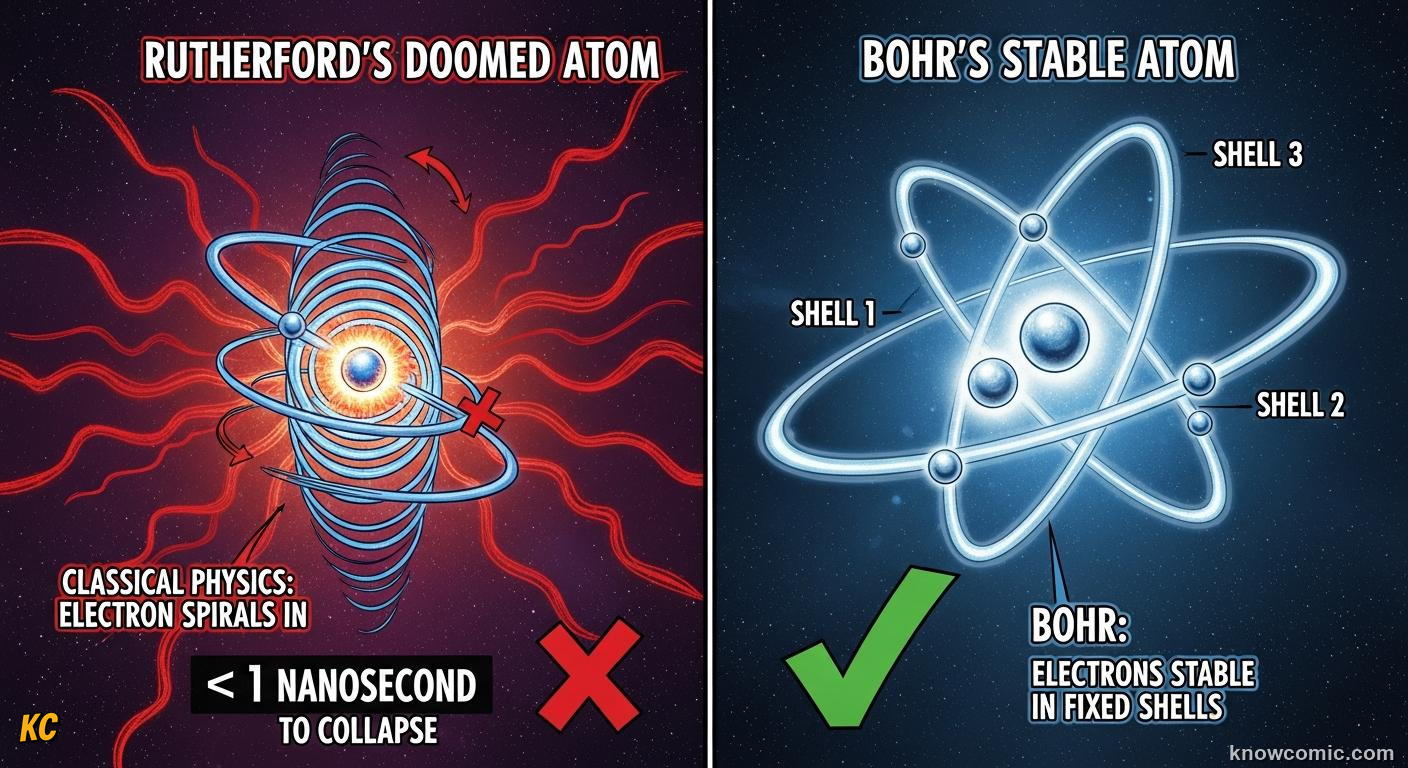
RUTHERFORD'S MODEL HAD A FATAL FLAW
Rutherford's nuclear model was revolutionary, but it had a serious problem. According to classical physics, a charged particle moving in a circle constantly accelerates. An accelerating electric charge must radiate energy as light. So the orbiting electrons in Rutherford's atom should continuously lose energy, spiralling inward and crashing into the nucleus in less than a billionth of a second. All atoms should be instantly unstable, yet clearly they are not! Something was missing. A young Danish physicist named Niels Bohr arrived at Rutherford's lab in 1912 determined to fix this.
🔬 NIELS BOHR
Bohr was 27 years old when he solved the problem. He used the brand-new quantum theory of Max Planck and Albert Einstein to place electrons into fixed energy levels, a revolutionary idea at the time.
SPIRAL!
THE CLASSICAL PREDICTION

🌀 Orbiting electron = accelerating charge
💡 Accelerating charge radiates light
💥 Electron loses energy → spirals inward
💡 Accelerating charge radiates light
💥 Electron loses energy → spirals inward
THE QUANTUM RESCUE

🔒 Bohr: electrons can only exist at fixed shells
🚫 Between shells: no energy loss allowed
✅ Atoms are stable, this matches reality!
🚫 Between shells: no energy loss allowed
✅ Atoms are stable, this matches reality!