⚛️
🧬
🧪 KNOW CHEMISTRY · AGES 11–16

CHEMISTRY

⚪ Neutrons & Isotopes, The Neutral Glue of the Nucleus!

📖 350 Topics 🆓 FREE + PRO ⏱️ 5 min per comic 🧠 Quiz included
🔮
1920
Rutherford predicts neutral particle
1930
Bothe's mystery radiation
🎯
1932
Chadwick finds the neutron
🕰️
1946
Libby invents C-14 dating
🏥
TODAY
Isotopes in medicine & power
⚪ NEUTRONS & ISOTOPES
TOPIC 06 · CHEMISTRY · NUCLEUS · MASS · 1932–PRESENT
PAGE 1 OF 5, MEET THE NEUTRON
THE NEUTRAL HEAVYWEIGHT OF THE NUCLEUS
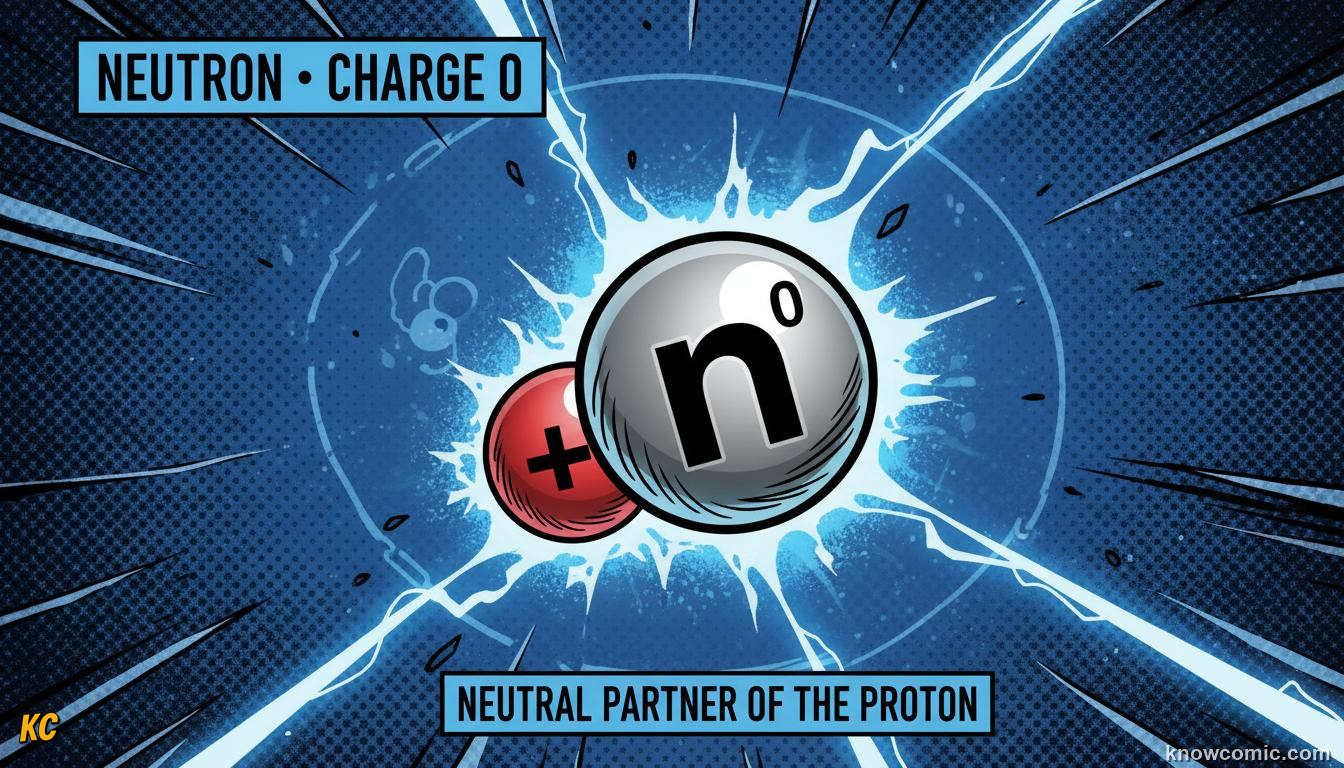
MEET THE NEUTRON: comic illustration from Topic 06: Neutrons & Isotopes
THE NEUTRON, THE NUCLEUS'S SILENT PARTNER
Sharing the tiny crowded nucleus with every proton is another particle, the neutron. Neutrons are almost the same size and weight as protons, but they carry no electric charge at all. That single fact makes them the secret to nuclear stability. A nucleus packed with only positive protons would fly apart instantly, same charges repel. Neutrons slip between the protons and act as nuclear glue, letting the strong force bind everything together without any electrical fight. Without neutrons there would be no carbon, no iron, no oxygen, in fact no element past hydrogen would ever form.
⚪ NEUTRON QUICK FACTS
Charge: 0 (neutral). Mass: 1.675 × 10⁻²⁷ kg (just a touch heavier than a proton). Symbol: n or n⁰. Discovered: 1932 by James Chadwick. Free neutron lifetime: about 15 minutes outside a nucleus.
NEUTRAL!
NUCLEAR GLUE
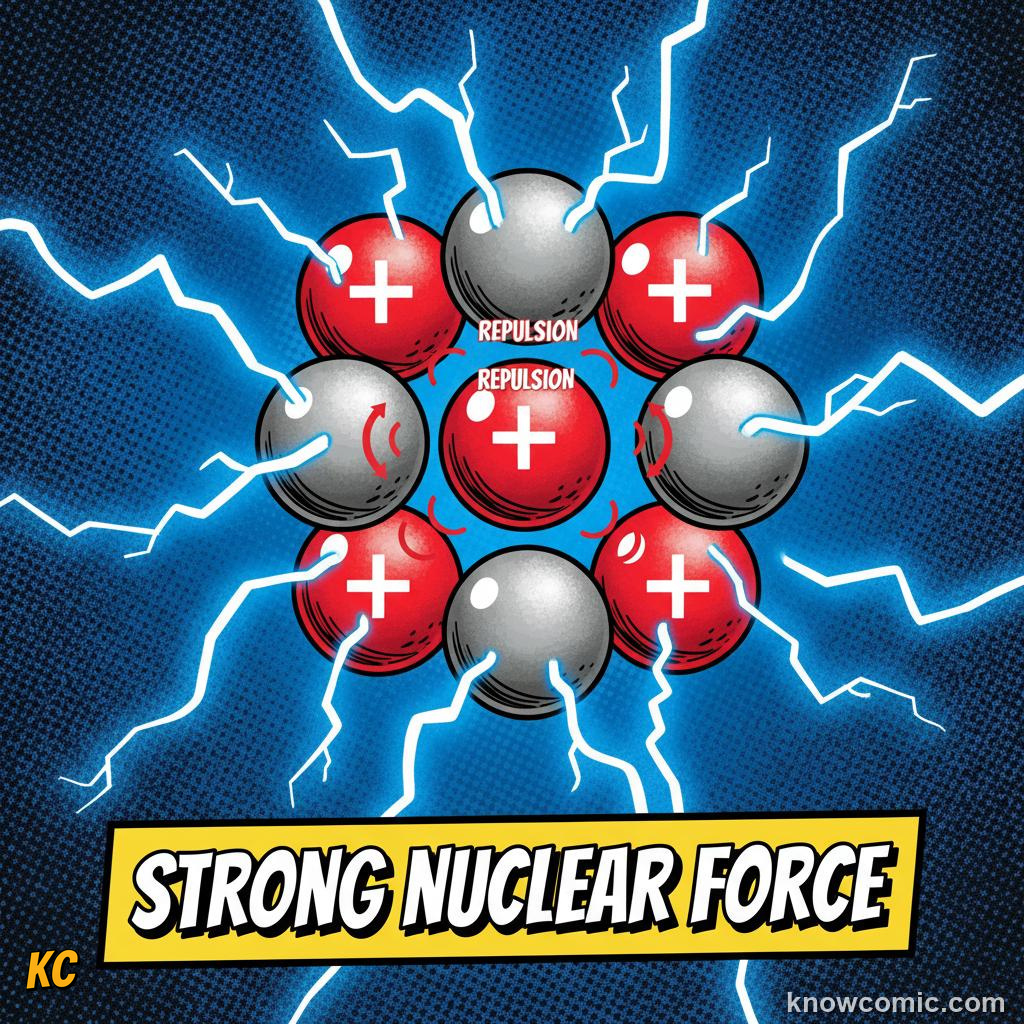
THE NEUTRON — THE NUCLEUS'S SILENT PARTNER: comic illustration from Topic 06: Neutrons & Isotopes
➕ Protons repel each other
⚪ Neutrons have no charge
🔒 Strong force binds them all
SIZE & MASS
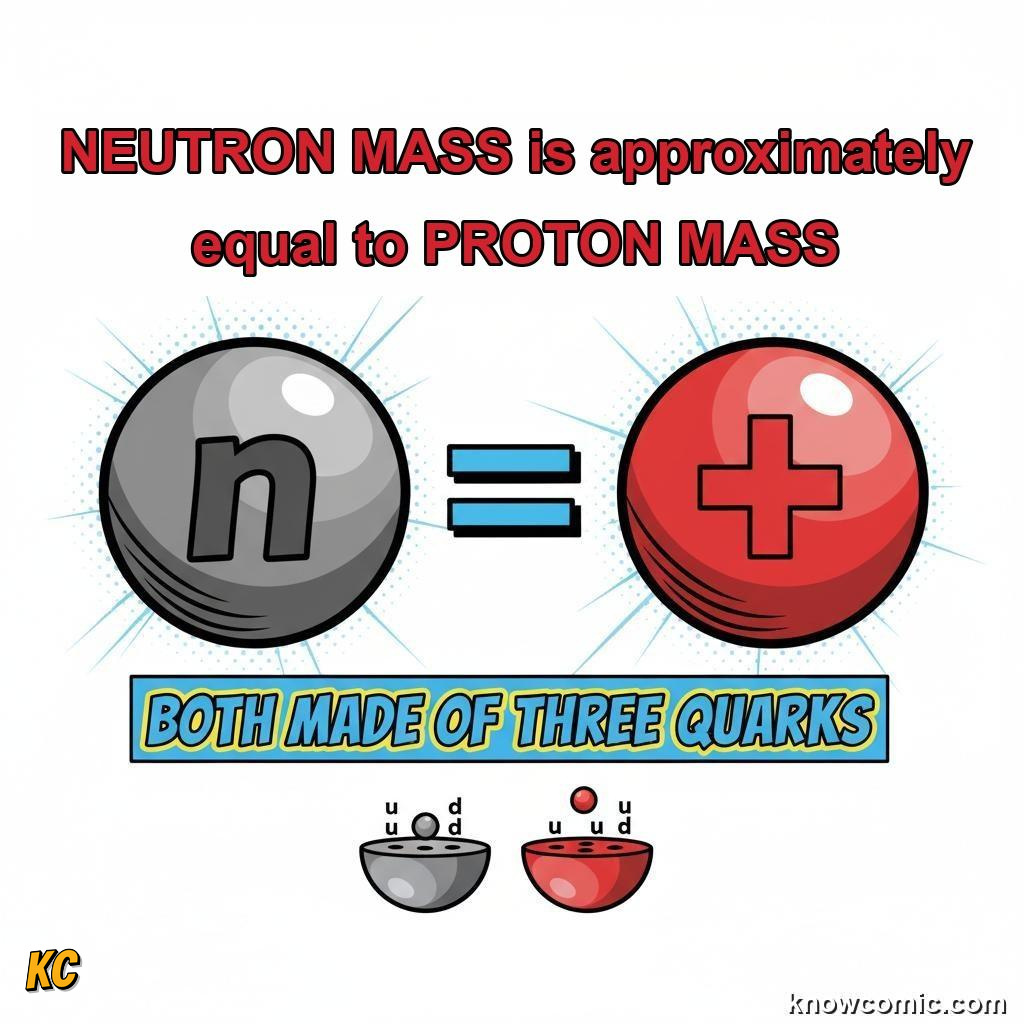
THE NEUTRON — THE NUCLEUS'S SILENT PARTNER: comic illustration from Topic 06: Neutrons & Isotopes
⚖️ Neutron mass ≈ proton mass
📏 About 10⁻¹⁵ metres across
🎯 Contains three quarks (udd)
PAGE 2 OF 5, CHADWICK DISCOVERS THE NEUTRON, 1932
CHADWICK'S BERYLLIUM EXPERIMENT
CHADWICK DISCOVERS THE NEUTRON, 1932: comic illustration from Topic 06: Neutrons & Isotopes
HOW CHADWICK CAUGHT THE INVISIBLE PARTICLE
In 1920, Rutherford had predicted a neutral particle must exist in the nucleus, but no one could find it, because it left no track in any detector. For twelve years the neutron stayed invisible. Then in 1930, Walther Bothe in Germany fired alpha particles at beryllium and discovered a strange penetrating radiation that punched straight through lead. Irène and Frédéric Joliot-Curie in Paris thought it was a powerful gamma ray. But James Chadwick at the Cavendish Laboratory in Cambridge had another idea. In 1932 he let the mystery radiation strike a slab of paraffin wax and carefully measured the protons it knocked out. The numbers only made sense if the invisible particle had the same mass as a proton but zero charge. Chadwick had found the neutron. He won the Nobel Prize just three years later.
🎯 THE KEY EQUATION
Chadwick's reaction: Be-9 + alpha → C-12 + neutron. An alpha particle striking a beryllium nucleus produced a carbon atom and knocked out one free neutron, the first neutron ever identified.
DETECTED!
🔮 1920 PREDICTED
HOW CHADWICK CAUGHT THE INVISIBLE PARTICLE: comic illustration from Topic 06: Neutrons & Isotopes
🧠 Rutherford predicts the neutron
❓ Needed to explain nuclear mass
🔎 Hidden from every detector
❓ 1930 MYSTERY RAYS
HOW CHADWICK CAUGHT THE INVISIBLE PARTICLE: comic illustration from Topic 06: Neutrons & Isotopes
🔬 Bothe fires alphas at beryllium
⚡ Strange radiation punches through lead
❓ Joliot-Curies think it's gamma rays
🏆 1935 NOBEL PRIZE
HOW CHADWICK CAUGHT THE INVISIBLE PARTICLE: comic illustration from Topic 06: Neutrons & Isotopes
🥇 Chadwick wins Nobel in Physics
📜 The atom model is finally complete
⚛️ Three particles: p, n, e
PAGE 3 OF 5, WHAT IS AN ISOTOPE?
ISOTOPE RULE
WHAT IS AN ISOTOPE?: comic illustration from Topic 06: Neutrons & Isotopes
🆔 Same element = same protons
⚪ Isotopes differ only in neutrons
⚖️ So they differ in mass, not chemistry
MASS NUMBER (A)
WHAT IS AN ISOTOPE?: comic illustration from Topic 06: Neutrons & Isotopes
🔢 A = protons + neutrons
➗ Neutrons = A − Z
🏷️ Written as element-A (e.g. Carbon-14)
ISOTOPES ARE ATOMIC TWINS WITH DIFFERENT WEIGHTS
WHAT IS AN ISOTOPE?: comic illustration from Topic 06: Neutrons & Isotopes
SAME ELEMENT, DIFFERENT NUMBER OF NEUTRONS
Every atom of hydrogen has exactly one proton, but the number of neutrons can vary. Hydrogen-1 (protium) has 0 neutrons, hydrogen-2 (deuterium) has 1 neutron, and hydrogen-3 (tritium) has 2. All three are hydrogen, all three have one electron and behave chemically the same, but they differ in mass. These are called isotopes, atomic twins with different weights. We label them by their mass number A (total protons plus neutrons), like carbon-12 or uranium-235. Most elements on Earth are actually a mix of several isotopes blended together, which is why the atomic masses on the periodic table are never exact whole numbers, they are weighted averages of each isotope's natural abundance.
🔑 ISOTOPE NOTATION
An isotope is written element-A or with A on top and Z on bottom. Example: Carbon-14, written ¹⁴C or C-14, has Z = 6 protons and A − Z = 14 − 6 = 8 neutrons. Two isotopes share the same Z but have different A values.
ISOTOPE!
PAGE 4 OF 5, FAMOUS ISOTOPES
THE THREE FACES OF HYDROGEN
FAMOUS ISOTOPES: comic illustration from Topic 06: Neutrons & Isotopes
EVERY ELEMENT HAS AN ISOTOPE FAMILY
Hydrogen has three natural isotopes: protium (H-1) with zero neutrons, deuterium (H-2) with one neutron, and tritium (H-3) with two neutrons. Protium makes up 99.98% of all hydrogen on Earth. Deuterium is rare but stable, combine it with oxygen and you get "heavy water" used in some nuclear reactors. Tritium is radioactive and decays in about 12 years, and it is used in glow-in-the-dark watches and fusion experiments. Carbon has two stable isotopes (C-12 and C-13) plus radioactive C-14, which is produced in the upper atmosphere and forms the basis of radiocarbon dating. Uranium has two important isotopes: U-238 (the common one, 99.3%) and U-235 (the rare fissile one used in nuclear reactors and bombs). Every element is really a small family of neutron-variations of itself.
🌍 ISOTOPES ON EARTH
There are about 3,300 known isotopes but only 254 are stable. Some elements, like tin, have ten stable isotopes; others, like fluorine and gold, have only one. Radioactive isotopes eventually decay by emitting particles or energy, transforming into another element or a lighter isotope.
FAMILY!
💧 HYDROGEN-1 · PROTIUM
EVERY ELEMENT HAS AN ISOTOPE FAMILY: comic illustration from Topic 06: Neutrons & Isotopes
🔢 1 proton, 0 neutrons
🌊 99.98% of all hydrogen
💧 The "H" in ordinary water
⚛️ CARBON-14 · RADIOACTIVE
EVERY ELEMENT HAS AN ISOTOPE FAMILY: comic illustration from Topic 06: Neutrons & Isotopes
🔢 6 protons, 8 neutrons
⏳ Half-life: 5,730 years
🦴 Used to date fossils & bones
☢️ URANIUM-235 · FISSILE
EVERY ELEMENT HAS AN ISOTOPE FAMILY: comic illustration from Topic 06: Neutrons & Isotopes
🔢 92 protons, 143 neutrons
💥 Splits when hit by a neutron
⚡ Fuels most nuclear reactors
PAGE 5 OF 5, ISOTOPES IN THE REAL WORLD
ISOTOPES POWER, HEAL AND DATE THE PLANET
ISOTOPES IN THE REAL WORLD: comic illustration from Topic 06: Neutrons & Isotopes
THREE WAYS ISOTOPES CHANGE THE WORLD
Isotopes are not just a neat idea, they are tools that transform medicine, archaeology and energy. Willard Libby realised in 1946 that living things absorb carbon-14 from the atmosphere at a steady rate, so by measuring how much C-14 remains in a bone, wood or shell, you can calculate how long ago it stopped being alive. This is radiocarbon dating, and it lets us put exact ages on fossils, cave paintings and mummies. In hospitals, tiny doses of radioactive iodine-131 image the thyroid and treat cancer, while technetium-99m is the most-used medical tracer on Earth. In power stations, the uranium-235 isotope is concentrated into fuel rods, then split by neutrons to release heat that turns turbines, generating around 10% of the world's electricity. One small difference in neutron count unlocks huge possibilities.
🧪 ISOTOPE SUPERPOWERS
Radiocarbon dating works up to about 50,000 years old. Medical imaging uses short-lived isotopes that decay within hours so they leave the body safely. Nuclear reactors need uranium enriched from 0.7% U-235 to about 3–5% U-235 to sustain a chain reaction.
POWER!
🔭 NEUTRON TIMELINE
THREE WAYS ISOTOPES CHANGE THE WORLD: comic illustration from Topic 06: Neutrons & Isotopes
1920 Rutherford predicts it
1932 Chadwick discovers it
1946 Libby builds C-14 dating
TODAY Isotopes power medicine
REMEMBER
⚡ KEY FACTS
Neutrons are neutral, mass ≈ proton mass. Isotopes have the same Z (protons) but different A (mass number). Neutrons = A − Z. Different isotopes have identical chemistry but different nuclear behaviour. Some are stable, some radioactive.
✅ Neutron charge = 0
✅ Same Z, different A = isotopes
✅ A = Z + N
✅ Chemistry is identical, mass differs
🧠 QUIZ TIME!
NEUTRONS & ISOTOPES · 5 QUESTIONS
QUESTION 01
What is the electric charge of a neutron?
QUESTION 02
Who discovered the neutron, and in what year?
QUESTION 03
Two atoms are isotopes of the same element. Which of these must be the same for both atoms?
QUESTION 04
Carbon-14 has an atomic number of 6. How many neutrons are in the nucleus of a carbon-14 atom?
QUESTION 05
Why is uranium-235 so important in nuclear power stations?
0/5
LOADING...
← TOPIC 05 📋 ALL TOPICS TOPIC 07 →